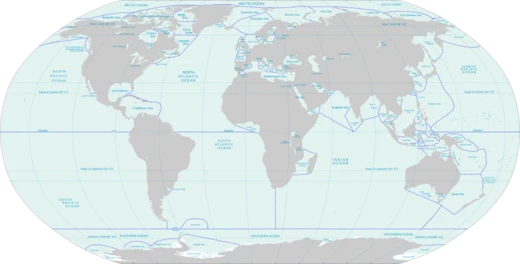
Suruga Bay
Deepest bay in Japan, shaped by tectonic subduction.
Suruga Bay lies on the Pacific side of Honshū, within Shizuoka Prefecture. Its boundaries run north of a line connecting Omaezaki Point to Irōzaki Point at the tip of the Izu Peninsula, with Honshū to the southwest and west and the Izu Peninsula to the east.
Down the bay’s center runs the Suruga Trough, the deepest such feature in Japan. This trough formed through the subduction of the Philippine Sea Plate beneath the Eurasian Plate, which also makes the area prone to earthquakes and accounts for the bay’s great depth. Several rivers, including the Fuji, Ōi, and Abe, empty into the western side, carving submarine canyons. At the eastern end, the Kano River flows into a small pocket called Uchiura-wan near Numazu. That side also features small rocky islands, some connected to the mainland by tombolos.
The western and central coast—roughly from Shizuoka to Numazu—is lined with sandy beaches like Yuigahama and Tagonoura. In contrast, the eastern and northeastern stretches, from Numazu down the Izu Peninsula’s southwestern coast to Irōzaki, are mostly rocky. The bay opens southward to the Philippine Sea and Pacific Ocean, but the Izu Peninsula shields it from oceanic waves. This protection, combined with the seabed and water conditions, creates good environments for fishing, sailing, windsurfing, swimming, and deep-sea organism research. A submarine plateau called Senoumi at the bay’s southwest end is especially known as a rich fishing ground.
Since Japan’s post-war industrial boom, the bay has suffered severe industrial pollution. By 1970, paper mills in Fuji were releasing 2.4 million short tons (2.2 million metric tons) of wastewater daily—equal to Tokyo’s entire sewage output at the time. The sulfur-laden sludge grew so thick it risked blocking the harbor, requiring dredging that badly damaged marine life. Protests from local citizens and fishermen pushed the government to act. Even with later regulations, surveys in the mid-2010s still found high levels of PCB and PBDE contamination in local sea life. The pollution became so notorious that it appeared in the 1971 film *Godzilla vs. Hedorah*; the monster’s name comes from *hedoro*, Japanese for “mud,” and it fed on the bay’s heavy pollution.
By car from Tokyo, Suruga Bay can be reached via Numazu in two to five hours, depending on traffic on the Tōmei Expressway or in Numazu itself.
- location
- Pacific coast of Honshū, Shizuoka Prefecture, Japan
- deepest_feature
- Suruga Trough (Japan's deepest trough)
- major_rivers
- Fuji, Ōi, Abe, Kano
- notable_fishing_ground
- Senoumi (undersea plateau at southwest end)
- key_environmental_issue
- Industrial pollution from paper mills in Fuji
Lore & Background
Suruga Bay was formed by tectonic subduction of the Philippine Sea Plate and the Eurasian Plate at the Suruga Trough, making it a source of considerable seismic activity and giving the bay its extreme depth. Numerous rivers—including the Fuji, Ōi, and Abe rivers—empty into the western portion, carving out submarine canyons. At the bay's easternmost end, the Kano River empties into a pocket called Uchiura-wan at Numazu. The eastern end holds a number of small rocky islands, some joined to the mainland by tombolos.
Reader's Guide
Suruga Bay is significant for its extreme depth, containing Japan's deepest trough, and for its role as a rich fishing ground, particularly at the undersea plateau known as Senoumi. The bay's western and central sections feature sandy beaches, while its eastern and northeastern stretches are rocky. The bay is open to the Philippine Sea/Pacific Ocean to the south but is mostly protected from oceanic waves by the Izu Peninsula, creating conditions favorable to fishing, sailing, windsurfing, swimming, and research on deep-sea organisms. However, the bay has suffered from severe industrial pollution since Japan's post-war industrial boom, with local paper mills in Fuji producing 2.4 million short tons of waste water daily by 1970. This pollution threatened to block the harbor and damaged marine life, leading to protests and subsequent regulations, though surveys in the mid-2010s continued to show intense PCB and PBDE contamination. The pollution became so infamous that it featured in the 1971 film Godzilla vs. Hedorah.
Did You Know?
- Suruga Bay contains the Suruga Trough, Japan's deepest trough.
- The bay was formed by tectonic subduction of the Philippine Sea Plate and the Eurasian Plate.
- By 1970, local paper mills in Fuji produced 2.4 million short tons of waste water every day.
- The pollution of Suruga Bay featured in the 1971 film Godzilla vs. Hedorah.
More in Straits, Channels, And Seas 1-24
Spotted an error? Know more?
This is a living reference — every entry is fact-audited, and reader corrections feed straight into our audit queue. Suggest an edit · See this site's audit record