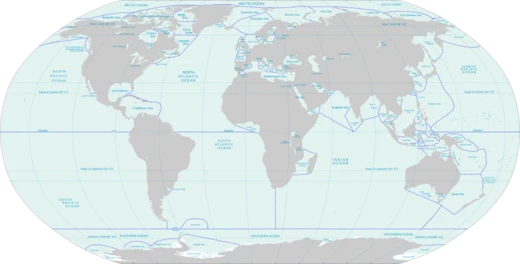
Strait of Otranto
Strategic strait connecting Adriatic and Ionian Seas.
The Strait of Otranto is a narrow sea passage linking the Adriatic and Ionian Seas, with Italy on one side and Albania on the other. At its narrowest point, between Punta Palascìa in eastern Salento and the Karaburun Peninsula in western Albania, it measures less than 72 kilometers (45 miles or 39 nautical miles). Its name comes from the Italian city of Otranto.
This strait has held major strategic importance for centuries. The Romans used it to move troops eastward: legions would march to Brundisium (modern Brindisi), cross the water in a single day to what is now Albania, and then continue east along the Via Egnatia.
During World War I, the strait again proved strategically vital. The Allied navies of Italy, France, and Great Britain set up a blockade—called the Otranto Barrage—using mostly light warships and armed fishing boats called drifters. Their goal was to keep the cautious Austro-Hungarian Navy from entering the Mediterranean, and they largely succeeded in that. However, the barrage was notoriously poor at stopping German and Austrian U-boats operating out of the Adriatic, which harassed Allied forces throughout the Mediterranean for most of the war.
After the Cold War, in 1992, Italy and Albania signed a treaty defining the continental shelf boundary between them in the strait. Administrative rights over the strait were given to Albania, a change that did not significantly alter the earlier arrangement. In 1997 and 2004, nearly 100 people died while trying to cross the strait illegally, following the 1997 unrest in Albania and poor economic conditions—events known as the Tragedy of Otranto and the Karaburun tragedy. In 2006, to curb organized crime, Albania banned motor-powered sailing boats on all its lakes, rivers, and seas, with exceptions for government-owned, foreign-owned, fishing, and jet boats. This moratorium was extended in 2010 to last until 2013.
The first recorded swim across the strait took place on July 14, 1979, when Italian long-distance swimmer Paolo Pinto swam from Italy to the Greek island of Fanos in about 40 hours and 42 minutes. In August 2024, Eva Buzo, a 36-year-old lawyer and long-distance swimmer from Sydney, became the first woman to complete the crossing, swimming 92 kilometers from Lecce, Italy, to Vlora, Albania, in 35 hours.
- location
- Between Italy and Albania
- width
- Less than 72 km (45 miles; 39 nautical miles)
- named_after
- Italian city of Otranto
- connects
- Adriatic Sea and Ionian Sea
- first_recorded_swim
- Paolo Pinto, July 14, 1979
- first_woman_swim
- Eva Buzo, August 2024
Lore & Background
During World War I, the strait was of strategic significance. The Allied navies of Italy, France, and Great Britain, by blockading the strait, mostly with light naval forces and lightly armed fishing vessels known as drifters, hindered the cautious Austro-Hungarian Navy from freely entering the Mediterranean Sea, and effectively kept them out of the naval theatre of war. The blockade was known as the 'Otranto Barrage'. However, the barrage was notoriously ineffective against the German and Austrian U-boats operating out of the Adriatic, which were to plague the Allied powers for most of the war throughout the Mediterranean.
After the fall of the Iron Curtain, in 1992, Albania and Italy signed a treaty that delimited the continental shelf boundary between the two countries in the Strait. Whatsoever the administration rights over the Strait were given to Albania not changing much from the former deal of Otranto. In 1997 and 2004, nearly 100 people died trying to illegally cross the strait following the 1997 unrest in Albania and poor economic conditions in the Tragedy of Otranto and the Karaburun tragedy. In 2006, the Albanian government imposed a moratorium on motor-powered sailing boats on all lakes, rivers, and seas of Albania to curb organized crime, with exemptions for government-owned boats, foreign-owned boats, fishing boats, and jet boats. In 2010, the moratorium was extended until 2013.
Reader's Guide
The Strait of Otranto has been a vital maritime corridor since Roman times, when legions marched to Brundisium for a one-day sea voyage to modern Albania. Its strategic importance peaked during World War I, where the Otranto Barrage—a blockade by Allied navies using light forces and drifters—sought to contain the Austro-Hungarian Navy, though it failed to stop German and Austrian U-boats. In the post-Cold War era, the strait became a site of tragedy and regulation: a 1992 treaty delimited the continental shelf, and in 1997 and 2004 nearly 100 people died attempting illegal crossings. Albania's 2006 moratorium on motor-powered boats aimed to curb organized crime, extended in 2010. The strait also gained notoriety for long-distance swims, with the first recorded crossing in 1979 by Paolo Pinto and the first woman crossing in 2024 by Eva Buzo. Its legacy is one of enduring geopolitical and human significance.
Did You Know?
- The Strait of Otranto is named after the Italian city of Otranto.
- During World War I, the Allied blockade of the strait was called the 'Otranto Barrage'.
- The first recorded successful swim across the strait was by Italian Paolo Pinto on July 14, 1979.
- In 1997 and 2004, nearly 100 people died trying to illegally cross the strait.
Frequently Asked Questions
What is the Strait of Otranto?
It is a narrow sea passage running between Italy's Salento peninsula and Albania's Karaburun Peninsula, serving as the link between the Adriatic Sea and the Ionian Sea.
How wide is the Strait of Otranto?
At its narrowest point, stretching from Punta Palascìa in eastern Salento to the Karaburun Peninsula in western Albania, the channel measures fewer than 72 kilometers (about 45 miles or 39 nautical miles).
Where does the name 'Strait of Otranto' come from?
The waterway is named after the Italian coastal city of Otranto, which sits on the Adriatic shore of the passage.
Why is the Strait of Otranto strategically important?
For centuries it has functioned as a critical military and trade corridor; Roman legions, for example, would march to Brindisi, cross the strait in a single day, and push onward into what is now Albania.
Who was the first person to swim the Strait of Otranto?
Paolo Pinto completed the first recorded crossing on July 14, 1979, while Eva Buzo became the first woman to swim the strait in August 2024.
More in Straits, Channels, And Seas 1-24
Spotted an error? Know more?
This is a living reference — every entry is fact-audited, and reader corrections feed straight into our audit queue. Suggest an edit · See this site's audit record