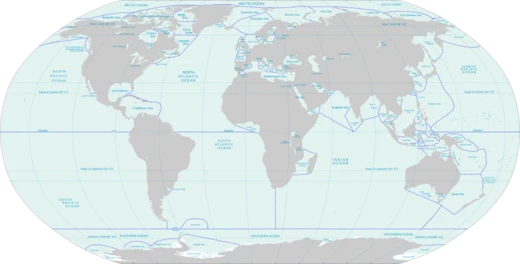
Straits of Florida
Strait between Florida and Cuba carrying the Gulf Stream.
The Straits of Florida—sometimes called the Florida Strait or Florida Straits—lie south-southeast of the North American mainland, between the Gulf of Mexico and the Atlantic Ocean, with the Florida Keys on one side and Cuba on the other. At its narrowest point, between Key West and Cuba, the strait is about 93 miles (150 km) wide and has been measured to a depth of 6,000 feet (1,800 m). The Florida Current, which marks the start of the Gulf Stream, flows through the strait from the Gulf of Mexico.
Between 1947 and 1962, five wells were drilled in state waters south of the Florida Keys, and Gulf Oil drilled three more in federal waters there in 1960 and 1961. All were dry holes. The boundary between the U.S. and Cuban Exclusive Economic Zones runs halfway between Cuba and Florida, as set by the 1977 Cuba–United States Maritime Boundary Agreement.
Off Cuba’s north coast, within 5 km of shore, three offshore oil fields are currently producing. The U.S. Geological Survey estimates that the North Cuba Basin holds about 5.5 billion barrels of undiscovered petroleum liquids and 9.8 trillion cubic feet of natural gas, nearly all offshore. During the 2008 U.S. elections, offshore drilling near Florida became a heated issue. In a June 5, 2008 column, George Will claimed a Chinese company was drilling in Cuban waters 60 miles from Florida—a claim repeated by pro-drilling candidates—but no such drilling was actually occurring. In 2004, Spain’s Repsol drilled in deep Cuban waters between Cuba and the Florida Keys, finding oil that was deemed noncommercial, and the well was plugged. In October 2008, Cuba signed an agreement with Brazil’s Petrobras to drill for oil and gas in deep waters off northern Cuba, but by May 2011 Petrobras had withdrawn due to poor prospects. In July 2009, Cuba gave Russia’s Zarubezhneft exploration rights off the same coast.
In 2009, Bharat Petroleum (registered in the Falkland Islands) and Norway’s Statoil announced a joint venture to drill in Bahamian waters north of Cuba and southeast of Florida. The Bahamas has said applications for offshore drilling are on hold while it negotiates exact Exclusive Economic Zone boundaries with Cuba, the United States, and the Turks and Caicos Islands.
The Gulf Stream carries a huge volume of seawater, along with heat, carbon, and other elements, shaping weather and climate—from sea levels along Florida to
- width_at_narrowest
- 93 mi (150 km)
- maximum_depth
- 6,000 feet (1,800 m)
- location
- Between Florida Keys (U.S.) and Cuba
- connects
- Gulf of Mexico and Atlantic Ocean
- key_current
- Florida Current (start of Gulf Stream)
Lore & Background
The strait has been the site of oil and gas exploration. Five wells were drilled in state waters south of the Florida Keys from 1947 to 1962, and Gulf Oil drilled three wells in federal waters south of the Florida Keys in 1960 and 1961; all were dry holes. The boundary between the Exclusive Economic Zones of the U.S. and Cuba is halfway between Cuba and Florida, as determined by the 1977 Cuba–United States Maritime Boundary Agreement. Cuba has three producing offshore oil fields within 5 km of its north coast opposite Florida. The U.S. Geological Survey estimates that the North Cuba Basin contains 5.5 billion barrels of undiscovered petroleum liquids and 9.8 trillion cubic feet of natural gas, almost all offshore. In 2004, the Spanish oil company Repsol drilled in deep Cuban waters between Cuba and the Florida Keys and found an oil deposit, but it was judged noncommercial and the hole was plugged. In October 2008, Cuba signed an agreement with Petrobras to drill for oil and gas off the north shore of Cuba; by May 2011, Petrobras had withdrawn due to poor prospects. In July 2009, Cuba signed an agreement with Russia giving Zarubezhneft exploration rights off the north shore of Cuba.
Reader's Guide
The Straits of Florida are significant for their role in global ocean circulation, carrying the Florida Current, which is the beginning of the Gulf Stream. The Gulf Stream transports immense volumes of seawater, heat, carbon, and other elements, shaping weather and climate, affecting sea level along Florida's coastline and temperature and precipitation patterns across continental Europe. Recent studies have shown that climate variability in the tropical Pacific can influence the Florida Current, and the current has been studied as a potential renewable energy resource. A thirty-year high-resolution simulation demonstrated consistent energy flow in the Straits, suggesting the region could be a site for marine energy research. Despite sub-seasonal variability, long-term observations over four decades show the Florida Current’s overall transport has remained steady. Localized features such as mesoscale eddies also shape the Straits; a 2022 study documented a long-lasting cyclonic eddy that increased primary production and redistributed nutrient-rich waters. The strait is also notable for swim crossings: Australian Susie Maroney swam it with a shark cage in 1997, and American Diana Nyad swam it without a shark cage in 2013 at age 64, taking 52 hours and 54 minutes to cover 106 miles between Havana and Key West.
Did You Know?
- The strait is 93 miles wide at its narrowest point between Key West and Cuba.
- All five wells drilled in state waters south of the Florida Keys from 1947 to 1962 were dry holes.
- In 2004, Repsol found a noncommercial oil deposit in deep Cuban waters between Cuba and the Florida Keys.
- Diana Nyad swam the strait without a shark cage in 2013 at age 64, taking 52 hours and 54 minutes.
Frequently Asked Questions
What is the Straits of Florida?
It is a stretch of open water sitting between the Florida Keys and the island of Cuba, serving as the waterway that links the Gulf of Mexico to the Atlantic Ocean.
How wide and deep is the Straits of Florida?
Measured at its tightest squeeze between Key West and Cuba, the strait spans roughly 93 miles (150 km) across, and its deepest surveyed point plunges to about 6,000 feet (1,800 m).
What current flows through the Straits of Florida?
The Florida Current moves through the strait out of the Gulf of Mexico, and this current is widely recognized as the birthplace of the much larger Gulf Stream system.
Which two landmasses form the boundaries of the Straits of Florida?
The U.S. territory of the Florida Keys lines one side of the channel, while the island nation of Cuba forms the opposite shore.
Why do fans of ocean geography consider the Straits of Florida significant?
It acts as the critical gateway where Gulf of Mexico waters pour into the Atlantic, and because it marks the origin of the Gulf Stream, it plays a outsized role in global ocean circulation and regional climate.
More in Straits, Channels, And Seas 1-24
Spotted an error? Know more?
This is a living reference — every entry is fact-audited, and reader corrections feed straight into our audit queue. Suggest an edit · See this site's audit record